| Intermediate Technology Education | Energy and Power Technology | Pre-Design | Topic 3 | Optional Activity 2 |
Direct Current
- Take voltage measurements and record them in a table.
- Create a graph of voltages with respect to time
- Recognize Direct Current from a graph
Direct Current
The very first form of electricity generated by humans came from a device called a wet cell. The cell was invented by Allessandro Volta and used 2 different metals (copper and zinc) which were placed in a jar of weak acid. Since this was the very beginning of man's discovery of current electricity, Volta had no measuring devices that could show him the properties of his discovery. In fact the measurement of electric potential difference was still years in the future, a measurement that would eventually be named for him.
Direct Current Electricity
Cells, or combinations of cells, called batteries deliver the purest form of DC electricity. Did you know that just about all electronic devices run on Direct Current electricity either from batteries or DC power supplies. But what is direct current?
Before we answer that question, lets look at how we can represent the electric potential difference (from now on referred to as voltage) of a source of electricity, let's say a battery.
If you connect your multi-meter to a battery box which has 2 D-cells and set the range to 20 volts, you will get a measurement that gives an indication of how "good" the cells are. If you take a series of measurements and note the time for each you can construct a simple table to show your results. Here is an example:
| Voltage | 3 | 3 | 3 | 3 | 3 | 3 | 3 | 3 | 3 | 3 |
| Time (s) | 1 | 2 | 3 | 4 | 5 | 6 | 7 | 8 | 9 | 10 |
Table. Voltage Readings over Time
You can represent the table above as a graph. If you plot voltage on the y-axis and time on the x-axis, your graph would look like this:
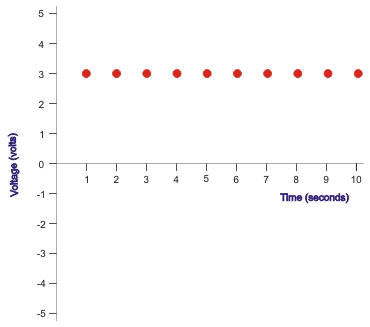
Figure. Voltage—Time graph with voltage points plotted
Although we haven't measured between 1 and 2 seconds or for any other of the time intervals, it might be a safe bet to say that the voltage is probably the same so we might complete the graph by connecting the points with a line as shown below:
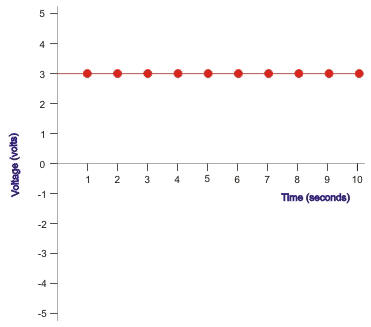
Figure. Voltage—Time graph with voltage points connected
Of course this is very theoretical! You need to find out for yourself.
For More information
For more information on these topics, check out these web pages
When you are ready, go to Your Turn
 Copyright 2007 Virtual Ink Ltd. Used under license