| Intermediate Technology Education | Energy and Power Technology | Design Stage 2 | Topic 6 | Optional Activity 7 |
Solar Construction Challenge
- Learn that photovoltaic solar arrays produce the most energy when they face the sun
- Learn that a stationary array, such as on a house roof, only produces its maximum energy for a short time each day
- Construct a device that will allow a solar array to produce its maximum energy for most of the day
Solar Tracking
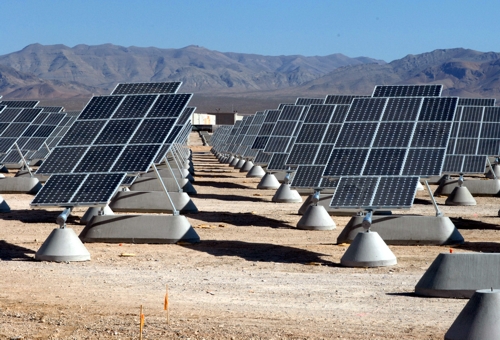
If your were to measure the energy output of a stationary solar array over a the course of a day and graph is to illustrate the efficiency of the system you would probably get something like the next illustration.
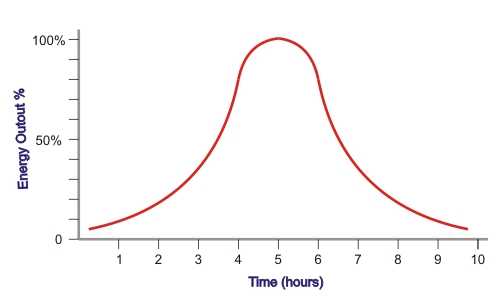
Figure. Energy output for a stationary solar array
Obviously, the array is only outputting its maximum energy for a short time each day when the sun's rays are perpendicular.
If the array were mounted on a system that tracked the sun, an ideal graph on a sunny day should look like the following
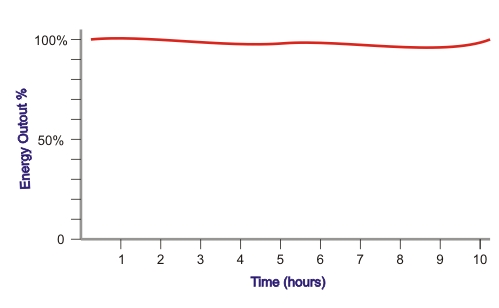
Figure. Energy output for a solar tracking solar array
Large photovoltaic arrays and solar concentrating mirrors are only cost effective if they are designed to track the sun, usually under computer control. An effective system must be able to move in two directions as the sun's path is not a straight line. The system must be able to move from east to west (called azimuth) and up and down (called elevation). At the end of the day, when the sun sets, the system must be able to return in an eastward direction to be ready for the next sunrise.
Systems can be built that follow a pre-determined path based on astronomical data that predicts where the sun will be at various times of the day. It must also account for the sun's change of latitude with the seasons. Other systems use light sensors to keep the array on target and return it to a "home" position at sunset.
For More information
For more information on these topics, check out these web pages
When you are ready, go to Your Turn
 Copyright 2007 Virtual Ink Ltd. Used under license