| Intermediate Technology Education | Energy and Power Technology | Design Stage 2 | Topic 6 | Optional Activity 5 |
The Miller Engine
- Explore collection of solar energy with small solar cells and storage of the collected energy in capacitors
- Learn how the stored energy can be applied in "pulses" to power small motors
- Build a small vehicle to test the concept
The Solar Engine
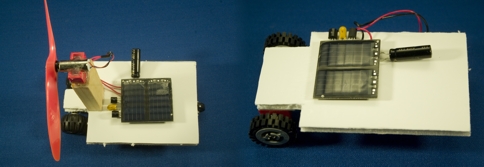
Figure. Small vehicles powered with Miller Engines
In a previous activity you used a large solar cell array which delivered a high current to power a wheeled vehicle. The array was connected directly to the motor which operated as soon as the light level was high enough and stopped when the light level dropped.
There is an alternate strategy for using solar energy—collect it with much smaller solar cells, store it in a capacitor and when the voltage rises to a certain point, dump the energy to a motor and then repeat the process.
This method is at the heart of a popular hobby called BEAM robotics which stands for Biology, Electronics, Aesthetics, Mechanics. The idea is to create small robots (which are generally powered by solar energy) that mimic small life forms such as insects.
One form of power plant for BEAM robots is called the Miller Solar Engine, named for Andrew Miller who designed the circuit in the mid 1990s. The Millar engine uses a handful of electronic components to capture, store, and use light energy.
The links below contain short video clips of vehicles which use the Solarbotics version of the miller engine.

Video. Three Miller Engine Vehicles
How Does it Work
The Miller Solar Engine you will use in this activity has a large capacitor which is charged up by the solar cell. A device called a voltage trigger monitors the voltage as the capacitor charges and at a set point, turns on a solid state switch called a transistor which turns on a motor. A second, smaller capacitor determines how long the motor stays on. When the charge in the large capacitor drops below a certain level, the motor stops and the process repeats.
For More information
For more information on these topics, check out these web pages
When you are ready, go to Your Turn
 Copyright 2007 Virtual Ink Ltd. Used under license