| Ottawa, Ontario
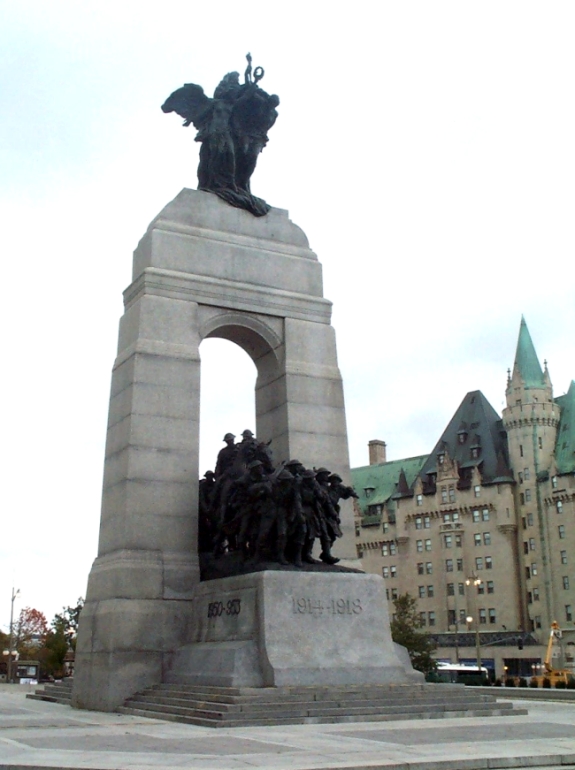
Designed originally to commemorate the 60,000 Canadians who died in the First World War, the National War Memorial in Confederation Square has since come to commemorate all of Canada's war dead.
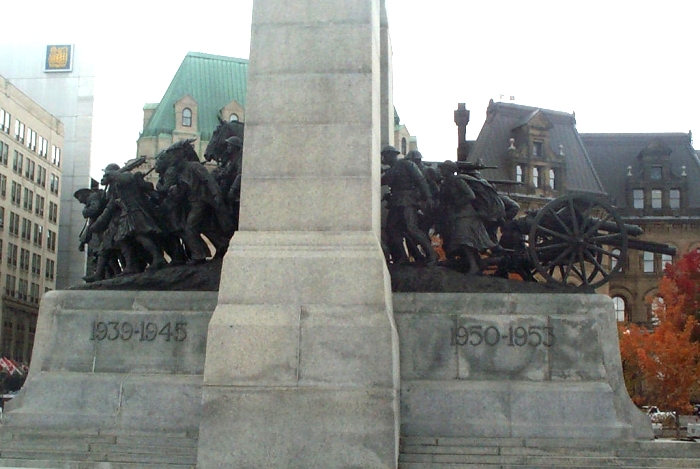
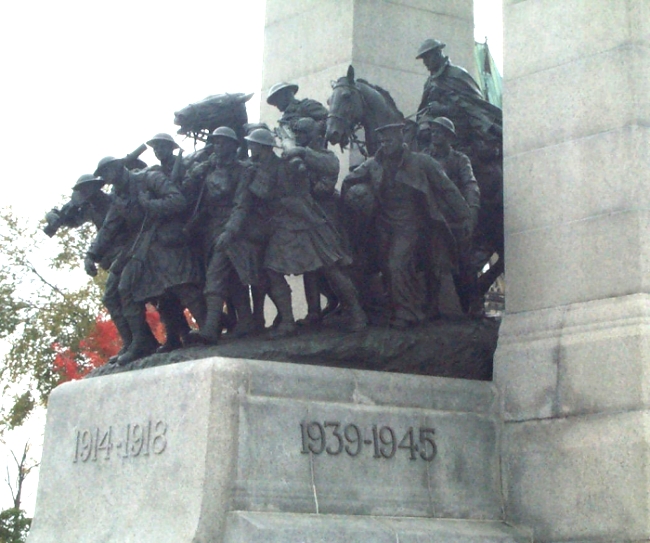
In 1982, the bronze numerals, 1939-1945 and 1950-1953 (Korea), were added to honour the fallen in the Second World War and in Korea.
The competition for the memorial's design, announced in 1925, was open to British subjects and to subjects of nations allied with the British Empire during the war. It stipulated that, while the spirit of heroism and self-sacrifice should be commemorated, there should be no attempt to glorify war. Vernon March of Farnborough, Kent, in England, was selected for his concept of "the Great Response of Canada" represented by twenty-two members
of the main forces in uniform passing through a granite arch under the guidance of allegorical figures of Peace and Freedom. Delayed for many years by problems of site selection and preparation, as well as by the death of the sculptor (his six brothers and one sister completed the work), the memorial was not officially dedicated until 1939, less than four months before the start of World War II.
Remembrance Day ceremonies are held here annually on November 11.
Three military figures awaiting to be mounted onto the Confederation Square National War Memorial's base. Some idea of their size can be visualized in comparison to one of the March Brothers who supervised the erection.
Installing the bronze military figures on the Memorial. Note the design of the on-site crane used for lifting heavy objects.
A side view of the National War Memorial.
Click on picture for a larger view.
A front view of the National War Memorial
Click on picture for a larger view.
|